
Modular, flexible and reliable in operation
Located between Lake Krøderen and the town of Noresund, approximately 90 km northwest of Oslo, the Norefjell Wastewater Treatment Plant serves an area with highly variable seasonal loads. When the facility was upgraded in 2020, the project adopted an approach that differs from traditional wastewater treatment plant design, but one that is increasingly being applied in modern water and wastewater infrastructure.
– By developing the plant as a modular process facility, the design allows for flexible adaptation and future expansion over time. While the mechanical scope may represent a higher initial investment compared to conventional solutions, the overall life-cycle cost is favourable, and the plant is better prepared to meet both current and future requirements, explains Andreas Riedel, Technical Manager at Hydria Water.
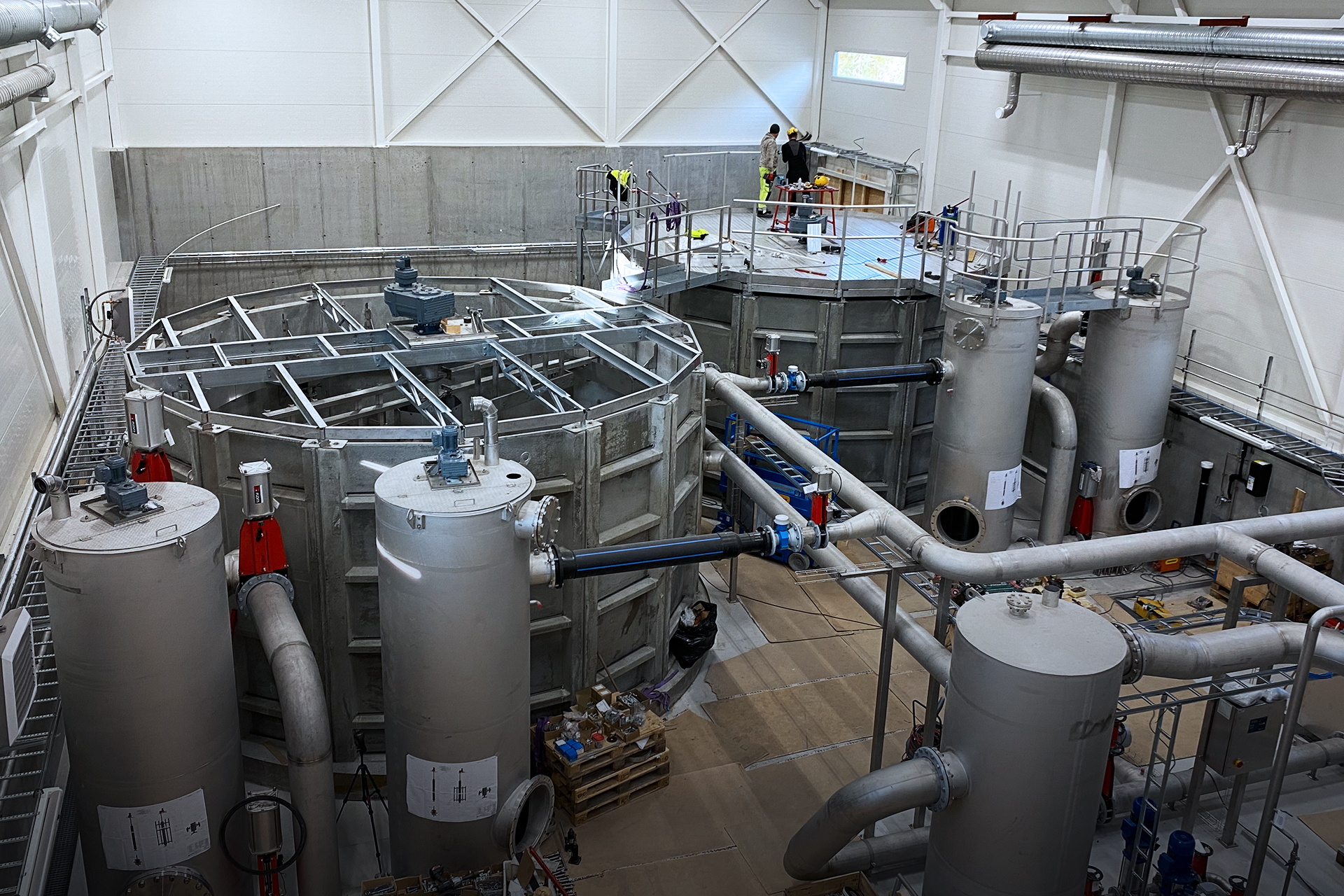
Traditional wastewater treatment plants are often based on cast-in-place concrete channels and basins with fixed geometries. In contrast, a modern process plant is built around prefabricated tanks and equipment installed on a concrete slab. This results in a fundamentally different civil design approach and significantly greater flexibility in process configuration.
– Installing or replacing a steel tank is considerably simpler than modifying concrete structures. As a result, the plant is not locked into a single configuration from the outset. This approach also makes it possible to adjust process capacity based on actual loading conditions, rather than designing solely for uncertain future peak demands, says Riedel.
The Norefjell Wastewater Treatment Plant is designed with two parallel treatment lines. This provides high operational reliability and enables efficient handling of large seasonal variations in both hydraulic and organic loading. This is particularly important in the Norefjell area, where wastewater volumes increase significantly during the winter season due to tourism and recreational housing.
– Combined with sedimentation as the primary separation process, the plant offers a robust, easy-to-operate and energy-efficient solution with high accessibility and clear process overview, Riedel adds.
Efficient Installation and a highly satisfied client
In this project, Hydria Water was responsible for the complete hydraulic process design of the preliminary treatment stage, from inlet to sedimentation.
– Hydria Water was entrusted with the delivery of all mechanical equipment required for separation and preliminary treatment. The scope included spiral screens, distribution chambers ensuring full redundancy, interconnecting pipework between process stages, grit removal units with grit classification, slurry suction pumps, grit washing systems and associated equipment. All components integrated seamlessly with the client’s requirements for hydraulic flexibility, piping layouts and ventilation systems.
Close collaboration between the client, consultants and supplier, supported by a shared 3D model, ensured excellent coordination throughout the project. This significantly reduced installation risks and made it straightforward to achieve a correct installation from the outset.
As a result of this successful coordination, commissioning and performance testing were completed in a very short timeframe, and the project was delivered to a highly satisfied client.
– We were impressed that Hydria Water managed to deliver such a large mechanical package in a single shipment, without any missing components. The packaging and labelling of the individual packages were very well organised, and the few missing items – two rubber components for the scraper blades of the rotating sludge scraper – were delivered promptly. The fit and finish of all machines, piping and components were also excellent, says Håvard S. Jakobsen, Engineer at Krüger Kaldnes AS, the main contractor for the project.
– The final result, and the exceptionally well-structured delivery of all our components, clearly demonstrates strong cooperation and effective communication. The solutions are fully tailored to this specific plant, and the sedimentation basins feature a unique and highly functional design. Space has also been reserved for future expansion, should this be required. This is a way of developing wastewater treatment plants that I would very much like to see more of in Norway, says Vladislav Kozlov, Sales Manager for Hydria Water in Norway.